


We hear a lot of talk about the market being overvalued relative to historical norms on a price-to-earnings ratio (or multiple) basis. I want to explain why that may not be as much of a concern as it's made out to be...
Market Valuation Basics
Price-to-earnings is determined by dividing the total value of a company by it's net earnings. For example, let's say company XYZ makes $1 million net profits in 2026, and the current total value of the company based on it's stock price is $20 million. This would imply a price-to-earnings (or P/E for short) multiple of 20. If that same company was valued at $10 million, it would have a P/E multiple of 10. If that company was valued at $30 million, it would have a P/E multiple of 30. P/E is simply telling us how much per dollar of earnings investors are willing to pay for a companies stock.
Lot's of things can impact this number. Companies that are growing their earnings faster typically are rewarded with a higher multiple. Companies that are growing more slowly are typically penalized with a lower multiple.
Campbells Soup, for example, trades at a P/E ratio of about 12, which is relatively low. Well, this is because that company has typically only grown earnings at about 6-8% per year. Investors are not willing to pay high multiples for a company that grows slowly. In 2025 they earned about $600 million of net profits, and the market valued the company at about $7.2 billion, or 12x their net profits (Hence, the P/E of 12).
Amazon, on the other hand, trades at a P/E ratio of 30. Well, this is in large part due to the fact that they grew their earnings by 30% from 2024 to 2025. Investors are willing to pay higher earnings multiples for companies that are growing faster. In 2025 Amazon's net profits were almost $80 billion, and the market valued the company at about $2.4 trillion, or 30x their net profits. Hence, the P/E of 30.
The total stock market is made up of thousands of companies that are all valued at different P/E multiples for reasons like I've shown above. But to get a sense of how the overall stock market is valued, we can find the average P/E multiple of all of the companies that make up the S&P 500.
You can see in the chart below that the historical average for this ratio for the S&P 500 is about 16. Today we stand at almost 22.
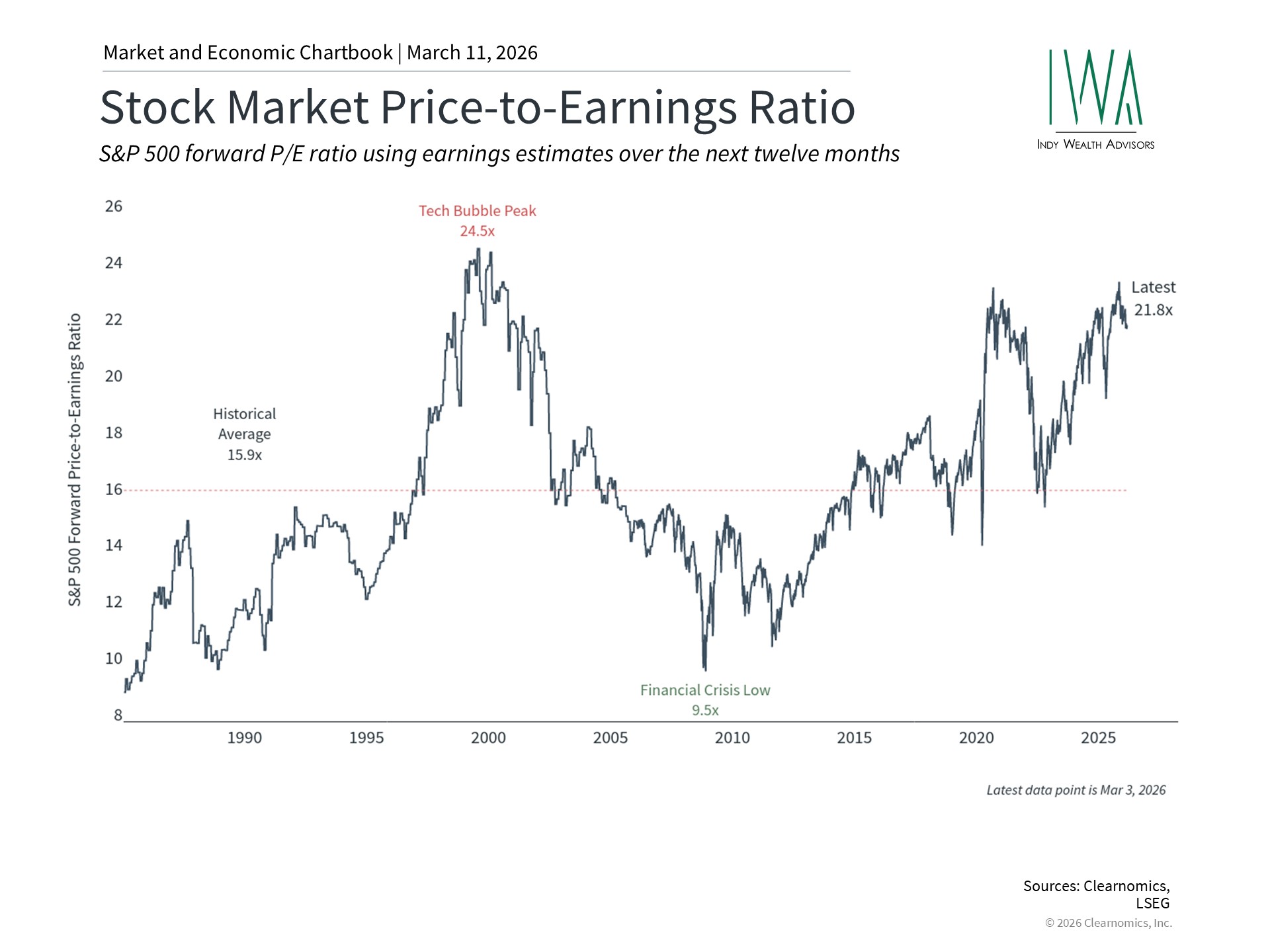
So on the surface it does appear that we are trading at significantly more expensive income multiples than what has been normal in the past. But, I may have an explanation for that....
You can see the data in that chart above begins around 1990. So I went back to 1990 to look at some basic supply and demand and growth fundamentals to compare to today...and what I found may explain why these multiples are higher today than they were back then.
Let's Start with Supply
Back in 1990 there were roughly 7,000 companies that were publicly traded, meaning you could buy and sell their shares in the stock market. That number actually peaked in 1996 at about 8,000 companies.
Today, however, that number has dropped to about 3,500.
There are various reasons for why this has happened....The rise of mergers and acquisitions is one. Larger more profitable companies buying up smaller companies to expand their reach. Plus, along the way, unprofitable companies may go out of business. This has resulted in fewer, but more profitable/higher quality companies making up the stock market.
Now Let's talk about Demand
Back in 1990, the 401k was pretty new. At that time pensions were much more common. About 72% of workers still had access to a pension. Most workers knew they had a guaranteed pension waiting for them at retirement so they didn't contribute all that much to their own retirement plans.
In 1990 there were only about 19 million Americans contributing to a 401k plan. The average participant only contributed about $2,500 per year and the total annual contributions to 401ks was about $45 billion per year. The average worker had a balance of about $18,000 and total combined assets in 401k plans in the US was about $385 billion.
Today, only 15% of workers have access to a pension plan which means the responsibility to save for retirement has fallen more heavily on the shoulders of the workers. This has led to a massive jump in 401k participation. Today 71 million Americans contribute to a 401k plan. The average participant contributes $7,800, bringing total annual contributions from all participants to $630 billion. The average individual 401k balance is about $150,000 and total combined 401k plan assets in the US now stands at more than TEN TRILLION DOLLARS.
And what do we know about how 401k plans are invested? Nearly 70% of all dollars flowing into 401ks are allocated to stocks.
So, to summarize, Americans are piling $630 billion a year (and growing) into their 401ks and 70% of that is going to buy stocks. That is an enormous increase in demand.
Supply vs Demand Summary
The supply of stocks to invest in has fallen 50% since 1990. Meanwhile the demand for stocks from 401k contributions alone has risen by about 1,300% since 1990. If supply is down, and demand is up, is it really a surprise that the prices we pay for stocks is higher today than it was back then?
Let's Not Forget Earnings Growth
The last thing to consider is earnings growth. I gave the example above of Campbells Soup vs Amazon and why investors are willing to pay a higher earnings multiple for Amazon vs Campbells. It comes down in large part to earnings growth. So let's apply that same logic to the overall market.
The historic average earnings growth rate for all of the companies that make up the S&P 500 is about 7.7%.
Current estimates for earnings growth in 2026 are nearly 15%. Which follows up on overall earnings growth of 12% in 2025.
So earnings have been and are expected to continue to grow at rates well above historical averages.
Just look at some of the largest companies in 1990 vs today.
In 1990 you had companies like Exxon Mobile, IBM, General Electric, And Coca Cola inside the top 10 largest publicly traded companies in the stock market. While solid companies, they weren't exactly exponential revenue growers. For these companies a good year would be 10% earnings growth. They were more focused on stability than hyper growth. Now compare those to the market leaders of today...
Nvidia grew earnings by 94% in 2025. Apple grew earnings at 25%. Google grew at 34%. Microsoft grew at 28%. Amazon, as we already mentioned, grew earnings by 30%.
If we know investors are willing to pay higher multiples for companies that are growing earnings at a higher rate...I ask you once again....Is it really a surprise to see that the average P/E multiple is quite a bit higher today than it was in 1990?
Conclusions..
For the reasons above, I think comparing P/E ratios today to P/E ratios from 30+ years ago is sort of apples and oranges. It's useful for those who are in the business of giving us things to worry about...ahem...the media. The media needs our attention and nothing grabs our attention more than things that worry us. Telling us the market is overvalued and in "bubble" territory is definitely a narrative that garners a lot of attention and sells a lot of advertising. But if we just look at the basic supply and demand fundamentals and sprinkle on top the earnings growth rate increasing, I think it starts to make more sense.
Now, does all this mean the market won't experience setbacks? Of course not. We will. Setbacks are normal. We'll go through many more 5%, 10%, 20% and even the occasional 30% drops along the way. I'm just telling you I don't believe we should be worried simply because P/E ratios are higher today than they were 30+ years ago.
Securities and advisory serviced offered through LPL Financial, a registered investment advisor.
Member FINRA/SIPC.
All investing involves risk including loss of principal. No strategy assures success or protects
against loss. LPL Financial does not provide tax or legal advice. This information is not intended to
be a substitute for specific individualized tax or legal advice. We suggest that you discuss your
specific situation with a qualified tax or legal advisor. The opinions expressed in this material do
not necessarily reflect the views of LPL Financial. An guests are not affiliated with or endorsed by
LPL Financial and Indy Wealth Advisors. Content in this material is for general information only and
not intended to provide specific advice or recommendations for any individual. All performance
referred is historical and is no guarantee of future results. All indices are unmanaged and may not
be invested into directly.
The primary benchmarks for the large-cap market are: S&P 500 index. The S&P 500 index is
considered the benchmark for the US Stock market. It is an index of approximately the largest 500
companies based on market capitalization. The Bloomberg Barclays U.S. Aggregate Bond index is
an index of the US investment-grade fixed-rate bond market, including both government and
corporate bonds.
Performance data for this video was collected from Clearnomics and Yahoo Finance as of the final
trading day of the previous month.