In this post I'll be reviewing month-to-date stock market results, Q1 earnings reports, and how the "experts" are, in my opinion, getting it wrong yet again. So let's get into it.
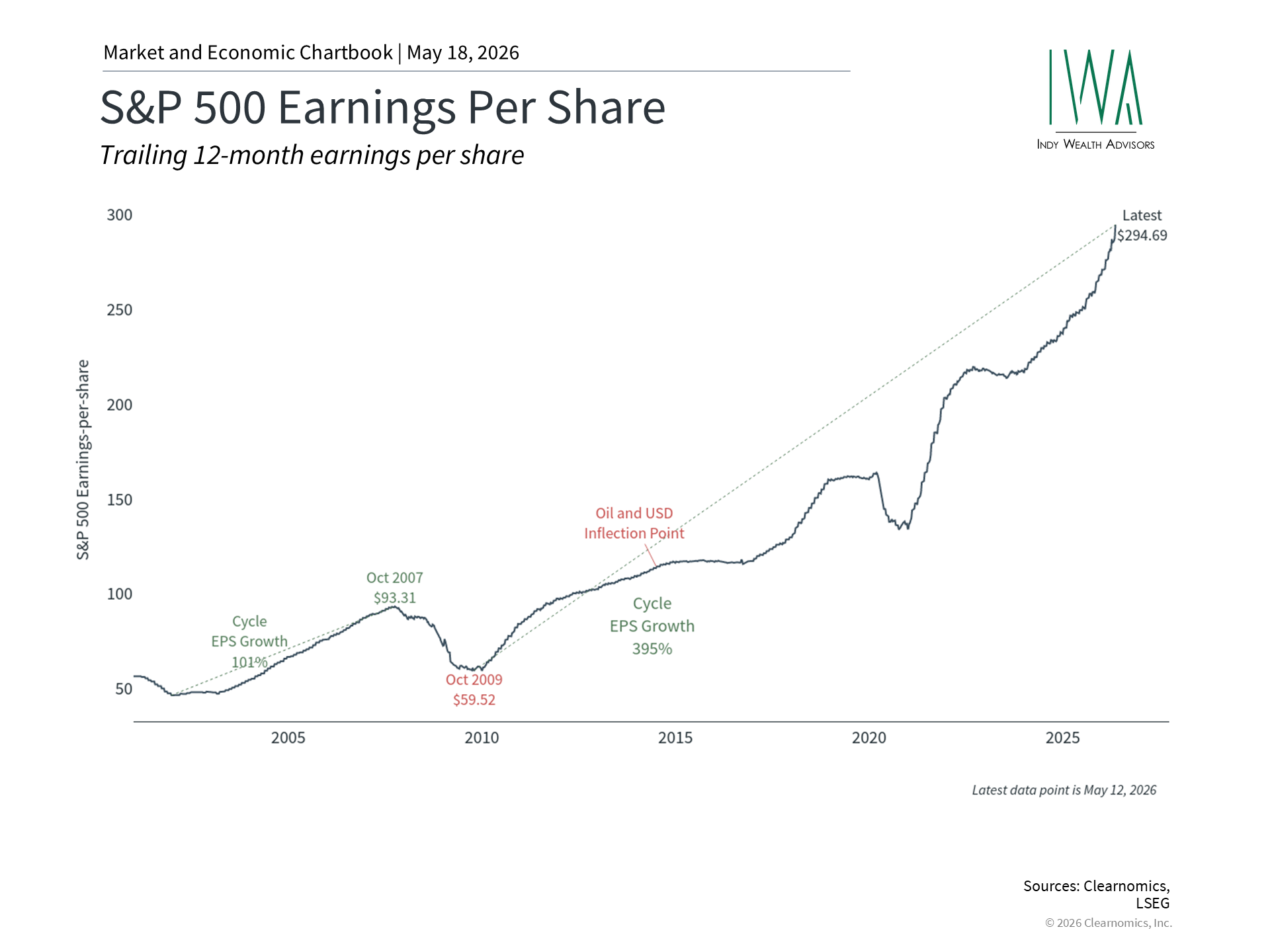
For starters, the S&P 500 is up about 3% for the month. This brings the year-to-date total return to a very solid 8%. Remember at one point back in late March we were down more than 7% for the year....But the market has erased all of that and then some over the past 6 or 7 weeks. The main driver here has been earnings. Earnings reports for the period from January through March have been superb. Coming into the quarter, analysts were expecting about 13% growth and the S&P 500 constituents are on track to double that number. I say it time and time again....Stock will tend to follow the earnings over the long term, and earnings are growing at a very strong rate. This is exactly why I was not worried back in March when the market was reeling. If you go back and watch or read my updates from that period I said forward earnings continue to look strong and eventually stock prices would reflect that.
You can see the acceleration in earnings in the chart below. When companies are growing faster, investors are willing to pay a premium for ownership. This is what drives the stock market higher over the long run.
 |
So where are the earnings coming from? Well....a lot of areas. But most notably, the technology sector is projected to report earnings growth of better than 60% for the January through March period when compared to that same time period from a year earlier. You hear a lot of talk about the stock market being in a "bubble" which I have pushed back against. People like to throw around the "bubble" term anytime the market is rallying simply because it draws attention and is a major buzzword that grabs people attention. But bubbles in the stock market form when prices are rallying without underlying earnings growth to support the rally. That is not what we are currently experiencing at all. Earnings are up and so are stocks. That's how it's supposed to work. People calling the current market a bubble are probably just upset that they've not been invested and experienced the benefits for themselves....or they're trying to sell you something by using fear.
Now does this mean we won't see a pullback in the future? Of course not! Pullbacks are a normal part of investing and the next one is always lurking somewhere on the horizon. The average year sees a correction of about 14% at some point. It doesn't mean anything is wrong....It's a feature of the stock market, not necessarily a symptom of something more serious. Nonetheless, the next time we get a pullback, the same people who have been talking about a bubble will certainly say "See! I told you!". Ignore them. Pullbacks are common and have always given way to a new recovery rally that leads us to higher levels. All we have to do is remain calm and invested. If we can just program our brains to accept that periodic bouts of volatility are inevitable, it makes them a lot easier to stomach when they happen. The only way a temporary drop in the market can actually hurt you is if you sell out of your investments in the middle of one. History shows us time and time again that simply staying invested has yielded positive results.
Now....on to my final discussion point....This is the "Here we go again" portion of the update...
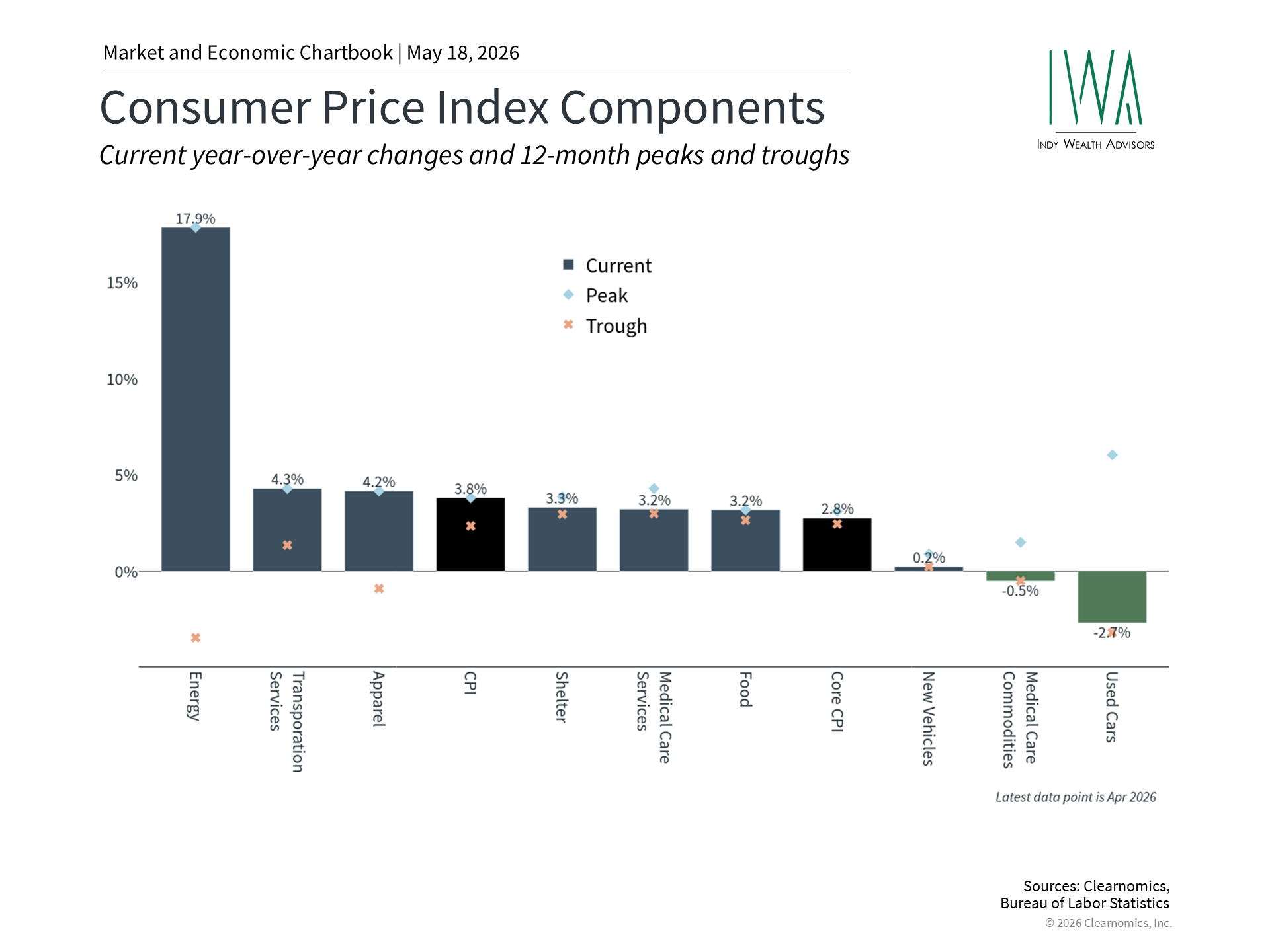
Recent inflation readings have been tracking higher...Well, duh. Oil prices have gone from $60 a barrel to $105 a barrel. Gas prices have gone from $2.20 to $4. Energy prices flow through to almost everything we do. They impact all areas of the economy. So of course current inflation readings are going to look high, but we know what is causing it. Energy prices spiked because of the conflict in Iran and the closure of the Strait of Hormuz through which 20% of the worlds oil passes. This bottleneck is leading to supply shortages which have driven up energy costs which are impacting all areas of the economy. Pretty simple...You can see it clear as day in the chart below which shows the components of inflation. Anything stand out as being the primary culprit?
 |
What's troubling is that I'm starting to see economists say the Federal Reserve should use it's tools to fight this inflation. In other words, the so called experts are calling for the Federal Reserve to once again raise interest rates. But let's just use common sense for a second....How does raising interest rates solve the oil supply bottleneck in the Strait of Hormuz? It doesn't. In fact it only makes things worse. It would raise costs for American consumers even more. We're already paying $4 a gallon for gas and somehow paying higher interest rates on auto and housing loans is going to help? Nonsense. And this is why I say "Here we go again".....I was very critical of the Federal Reserve's approach to dealing with inflation in 2022 and 2023 and I hope they don't make the same mistakes again. What is going to bring prices down is a resolution to the conflict in Iran and the re-opening of the Strait of Hormuz.....not raising interest rates. Let's hope common sense prevails.
That's going to be it for now. I'll check back in in a couple of weeks with my monthly Video update to recap the full month of May!
Best,
Nathan
Securities and Advisory Services offered through LPL Financial, a Registered Investment Advisor. Member FINRA & SIPC.
This material is for general information only and is not intended to provide specific advice or recommendations for any individual. There is no assurance that the views or strategies discussed are suitable for all investors or will yield positive outcomes. Investing involves risks including possible loss of principal. No investment strategy or risk management technique can guarantee return or eliminate risk in all market environments Any economic forecasts set forth may not develop as predicted and are subject to change.
References to markets, asset classes, and sectors are generally regarding the corresponding market index. Indexes are unmanaged statistical composites and cannot be invested into directly. Index performance is not indicative of the performance of any investment and do not reflect fees, expenses, or sales charges. All performance referenced is historical and is no guarantee of future results.
This information is not intended to be a substitute for specific individualized tax or legal advice. We suggest that you discuss your specific situation with a qualified tax or legal professional.
Bonds are subject to market and interest rate risk if sold prior to maturity. Bond values will decline as interest rates rise and bonds are subject to availability and change in price.
U.S. Treasury securities are guaranteed by the federal government as to the timely payment of principal and interest. The principal value of Treasury securities and other bonds fluctuates with market conditions.
International investments carry additional risks, which include differences in financial reporting standards, currency exchange rates, political risks unique to a specific country, foreign taxes and regulations, and the potential for illiquid markets. These factors may result in greater share price volatility.
This material was prepared by Clearnomics, Inc., who is not affiliated with the named financial professional, firm or broker/dealer.